
Stone in use
What our stone is for
Eight typical jobs across Lancashire, and the Bazel stone that suits each one. If yours looks like one of these, say so on the form.

Typical uses, from field wall to footing
These are the kinds of job we're getting ready to supply. Each one shows the stone that suits it, how the job goes together, and what to tell us when you register your interest.
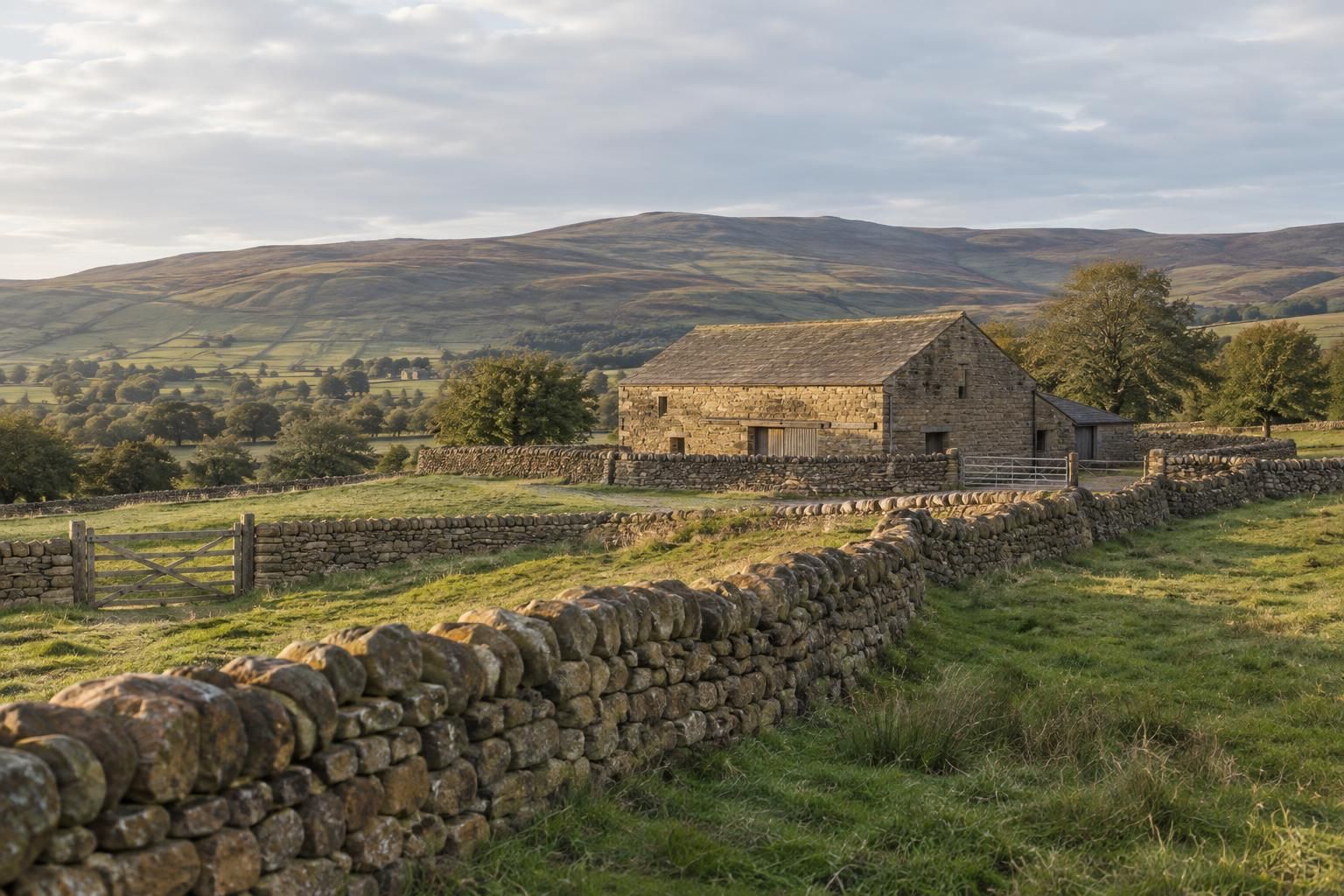
Drystone boundary wall, Ribble Valley farm
The job. A field boundary between pasture and a farm lane, where an old wall has slumped and gaps have been filled with wire. The wall is rebuilt as a double drystone wall, to sit with the old walls along the lane.


The stone. Random walling stone for the faces, copes to finish the top, and through-stones to tie the two faces together.
How it goes together. The fallen stone is sorted, footings are set on firm ground, and the two faces are built up with hearting packed between them. Through-stones go in halfway up, and copes finish the top.
What to tell us. The length of wall, whether you're reusing any fallen stone, and whether a tipper can get to the line of the wall.


Farm track and gateway, Bowland fell farm
The job. A farm track to an upland field barn, rutted and wet at the gateway where stock and machines turn. The track is rebuilt with a firm stone base and the gateway given a hard standing that won't churn up in winter.

The stone. Scalpings for the track and gateway, with fine chippings to blind the surface, and a pair of edging blocks at the gate.
How it goes together. The soft ground is dug out, the scalpings are spread and rolled in layers, and the surface is blinded with fines and rolled again, with a slight crossfall so water runs off.
What to tell us. The rough length and width of the track, how wet the ground is, and whether delivery is by tipper or you'll collect with a trailer.

Cottage garden rockery, Lune Valley
The job. A sloping front garden on a stone cottage, hard to mow and prone to washing out. The slope becomes a planted rockery with stone steps up the middle.


The stone. Rockery stone for the bank, split stepping stones for the steps, and sandstone dust to bed them.
How it goes together. Stones are set into the slope with a third of each piece buried, tilted back so the bank holds. Planting pockets go between them, and the steps are bedded on dust.
What to tell us. Roughly how big the bank is, whether you want to pick pieces by eye, and how close a vehicle can get to the garden.

Walls on farms, paths in village gardens, sub-base on a self-build plot.

Self-build plot sub-base, Fylde village
The job. A self-built bungalow on a flat village plot, with a drive and a garage base to go in once the house is up. Both need a firm base on soft ground.

The stone. Crushed sandstone sub-base for the drive and garage base, general fill to make up a low corner of the plot, and clean stone for a drain along the drive.
How it goes together. Topsoil is stripped, the low corner is filled and rolled, and sub-base is laid and compacted in layers to the level the surface needs.
What to tell us. The area of the drive and base, when the house will be ready for them, and whether a tipper can tip on the plot.

Garden path and patio bedding, Pendle village
The job. A back garden behind a stone terrace, with a muddy route to the gate and nowhere dry to sit. A stone-flag patio goes in by the house and a path runs down to the gate.


The stone. Crushed sandstone sub-base under the patio and path, sandstone dust for bedding and jointing, and rockery stone to edge the beds either side.
How it goes together. The ground is dug out, sub-base is laid and compacted, and the flags are bedded and jointed so the colour of the joints matches the stone.
What to tell us. The size of the patio and path, whether you're bringing your own flags, and how the stone will get from the road to the garden.
Crushed sandstone aggregates · Sub-base and fill · Rockery and landscape stone


Feature boulders on a hillside garden, Rossendale
The job. A steep garden on a hillside house, with a bare bank below the terrace. A group of boulders turns the bank into a feature and holds it in place.

The stone. Feature boulders and a seat stone, set with a few retaining blocks at the foot of the bank.
How it goes together. Each boulder is placed by machine, turned until its best face shows, and bedded deep enough to look as if it came out of the hill. Planting fills in between.
What to tell us. How many stones you have in mind, the access for a machine, and a photo of the bank.

Soakaway and land drain, Wyre smallholding
The job. A smallholding on flat, heavy ground where the yard floods every winter. A land drain is cut along the yard edge to a new soakaway in the paddock.


The stone. Clean stone, large for the soakaway, and clean stone, small around the perforated drain pipe.
How it goes together. The trench and soakaway pit are dug, the pipe is laid on a bed of clean stone and surrounded with more, and the pit is filled with larger clean stone before being capped and turfed.
What to tell us. The length of the drain, the size of the soakaway, and when the ground is dry enough to work.


Rear extension in matching stone, Lancaster terrace
The job. A sandstone terraced house getting a single-storey rear extension. The owners want the new walls to look as if they've always been there.

The stone. Squared building stone for the outer leaf, with random walling stone for a matching garden wall.
How it goes together. The stone is laid in courses to line up with the old house, with the joints raked back and the mortar coloured to suit.
What to tell us. A photo of the existing stonework, the size of the extension, and when your builder needs the stone on site.

Opening soon
Get your name down
We're getting ready to open. Tell us what you'll need and roughly when, and we'll be in touch as we open to arrange collection or delivery.
